Introduction: Nearly 100% of the UK adult population are considered frequent internet users (ONS, 2019). Alongside the increase in usage, an increase in the importance of online platforms has emerged for users in contemporary society. This has encouraged researchers to study online behaviour.
The Research: Goffman (1959) explains how individuals are conscious of presenting a desirable image, known as self-presentation (SP). (See video on Goffman, 1959)
Researchers have applied these principles to online behaviour, suggesting that the distance between the individual and the online self makes it easier to embellish or conceal aspects of the self (Subrahmanyam, 2011). Therefore, research has examined if accurate judgements of an individual’s personality can be made based on these online representations (Eftekhar, Fullwood & Morris, 2014; Wang, 2019). However, online platforms vary in terms of the opportunities for editing (e.g. social media and email) which may lead to differences in SP (Attrill, 2015). Therefore, it is important to examine differences between contexts, which previous research has not fully considered.
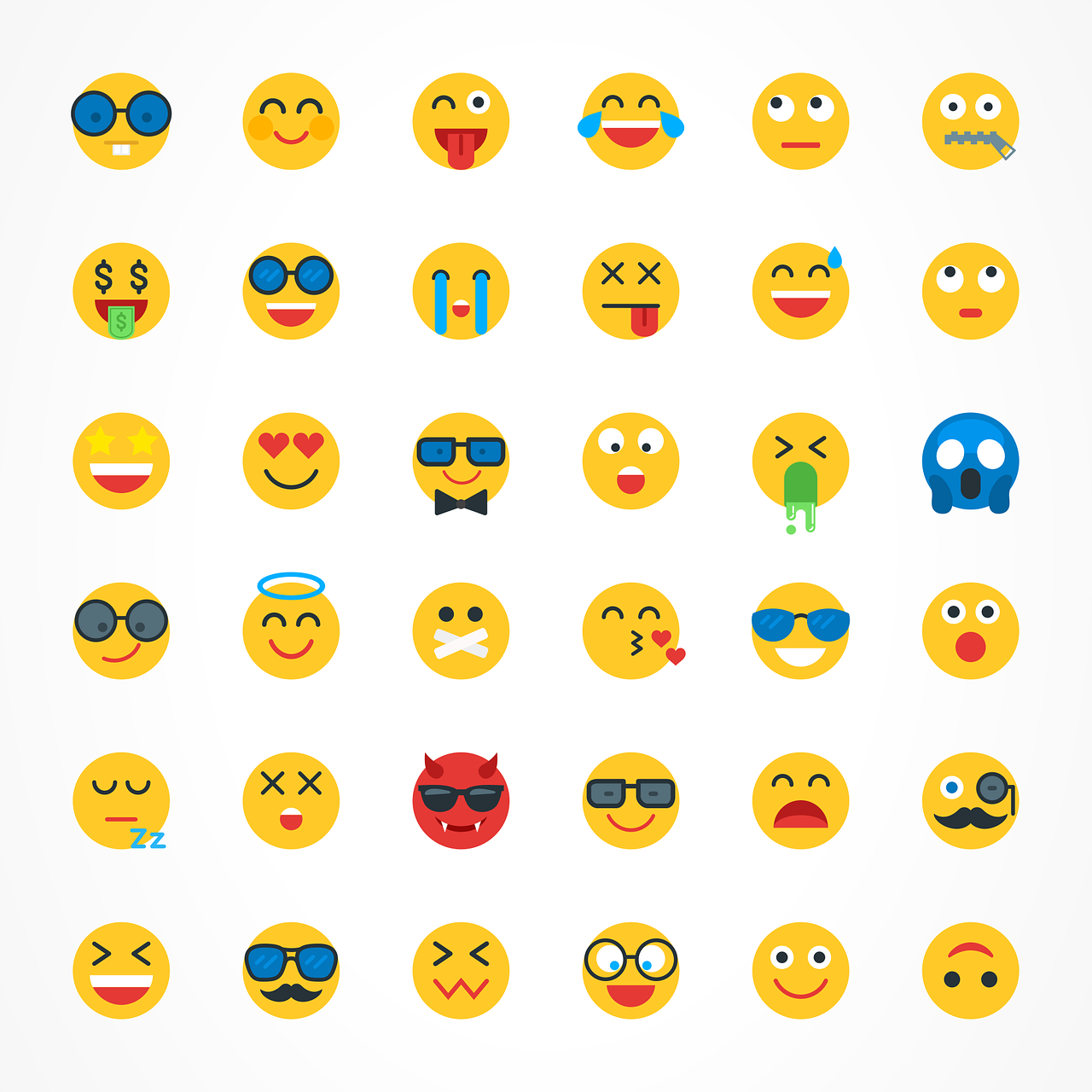
Emoticons may be useful when examining the relationship between SP and individual differences across contexts (Tossell et al., 2012). Emoticons are symbols which are used as online equivalents of facial expressions. They are used to show emotion, reduce ambiguity or to lighten the mood (Kaye, Wall & Malone, 2016). It may be that people use emoticons to control their behaviour.
What did the previous research miss?
- Models such as The Hyper-personal Computer Mediated Communication model (Walther, 1996), have failed to fully explain individual differences or the reasons why people disclose information differently across online contexts. (see https://psychology.wikia.org/wiki/Hyperpersonal_model).
- Little is understood about the psychological processes or the reasons why people behave in certain ways online (Mehdizadeh, 2010).
What did the study do?
The present study expanded on previous research (Wall, Kaye & Malone, 2016), as it was the first attempt to:
- Study 1- Explore the key psychological factors (SP, personality, social anxiety & self-esteem) associated with emoticon usage in different online contexts.
- Study 2- Examine how emoticon usage influences how people form judgements about another’s personality and how accurate these judgements are.
Methods/Results:
| Study 1 | Study 2 | |
| Who took part? | University psychology students (N=92) were recruited via an opportunity sampling method and were given course credit for participation. | N=7 observers (10 recruited but didn’t complete all responses). N= 5 females N=2 Males. All psychology undergraduates recruited via an opportunity sampling method. |
| How? | Correlational design- when you want to see if variables relate.In this case to examine the if SP, social anxiety, self-esteem, personality and type of platform is associated with emoticon use. | Correlational design was used to examine the role of context and emoticon usage on first impression accuracy of the Big Five personality traits. |
| Measures | Press the link to see measures used and to have a go yourself: https://aleesharamworks.business.blog/wp-content/uploads/2020/04/scales1.docx | Personality judgements- modified version of IPIP used in study 1 Measuring accuracy- (see Gosling et al., 2007 for more details on a similar procedure). |
| What did they do? | see step by step via link: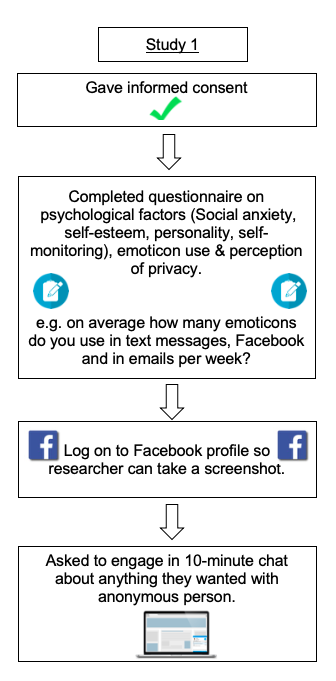 https://aleesharamworks.business.blog/wp-content/uploads/2020/04/tabel-of-cyber-changed-1.docx | Using the profiles and chats from study 1 (N=54) observers independently rated their impression of all 54 target participants. This was done in 5 sessions (over 5 weeks) x2 hours long. Observers made it clear that they not acquaintances with any target participants. |
| what was found? | Context and emoticon usage: A significant effect of context was found with most emoticon use being on Facebook. Facebook (M= 4.32, SE= 0.09) Email (M=3.98, SE= 0.13) Text messages (M=2.15, SE=0.16) Trait analysis of self-report emoticon usage across contexts: Agreeableness was associated with use on Facebook but no other contexts: Text messages Self-esteem, social anxiety & self-monitoring: Text messages Psychological factors and general SP strategies: Agreeableness- Modifying SP Extraversion- Modifying SP Self-esteem- Modifying SP BUT:Social anxiety, Social interactions and Social avoidance was negatively correlated with modifying SP. | Correlational analysis releveled: Consensus of observer’s judgments was best for traits such as extraversion and agreeableness: Extraversion- r=0.80 Agreeableness- r=0.64 Neuroticism- r=0.46 Openness- r=0.48 Conscientiousness- r=0.29 Agreement/ Accuracy between observers’ judgements and self-report personality scores from study 1: They had high accuracy for extraversion and openness in particular: Extraversion: r=0.74 Openness: r=0.43 Agreeableness: r=0.30 Consciousness= r=-0.14 Neuroticism: r= -0.03 The relationship between personality judgements and the use of emoticons revealed positive correlations between the use of happy emoticons and observers’ judgements of: Agreeableness: r=0.74 Conscientiousness: r=0.63 Openness: r= 0.63 |
Limitations:
The study only focused on emoticon usage. This doesn’t tell us about all the cues that observers may find useful when forming first impressions. Thus, future research should explore a range of online behaviours. This has been explored in previous research that has examined a range of online behaviours including, photo editing activity, tagging and status updates (Bachrach, Kosinki, Graepel, Kohli & Stillwell, 2012; Eftekhar et al., 2014; Marengo & Settanni, 2019).
Furthermore, the study doesn’t address why people use different types of emoticons or the purpose that they have for the users. Future research could explore this by conducting qualitative data as explored by Kaye et al. (2016).
Additionally, in study 2 the participants only observed Facebook profiles. However, it may be useful to examine a range of platforms to examine if emoticon use in different contexts, results in changes in impression formation. For example, emoticon usage in emails is often perceived as unprofessional (Gacey & Richard,2013). Other online platforms may also be useful to examine such as Instagram, which have more opportunities for SP such as photo-editing as it is a photo-based platform (Barry, Reiter, Anderson, Schoessler & Sidoti, 2019).
To conclude:
The current research expands on previous research and theories through a number of new findings:
Study 1:
What was found?
- Contextual differences in emoticon use (most usage on Facebook).
- Agreeableness was positively correlated with emoticon usage only on Facebook. This is understandable considering that Facebook provides many opportunities to embellish behaviour (Whitty, Doodson, Creese & Hodges, 2018).
- Agreeableness, extraversion and self-esteem was positively correlated with modifying SP but not the other traits.
Why is this important?
- Identified key psychological factors of online behaviour which has expanded on previous research.
- Findings have highlighted the importance of taking a context-specific approach in future research when examining online behaviour (Vanderiff, 2013).
Study 2:
What was found?
- Observers had high judgement accuracy for extraversion and openness which is support by previous research (Darybshire, Kirk, Wall & Kaye, 2016).
- Positive relationship between the use of “happy” emoticons and judgement’s on agreeableness, openness and conscientiousness. This suggests that the use of happy emoticons is seen as socially desirable (Riggio & Friedman, 1986).
Why is this important?
- The research has added to the current research on how online behaviour influences impression development.

Overall implications:
Reliance on online platforms has increased in contemporary society (e.g. online dating and online job recruitment). First impressions are essential in these circumstances. This research on how people present themselves online and how first impressions are formed, can be significant in enabling users to present themselves better (Gardner, Reithel, Gogliser, Walumbwa & Foley, 2012).
References:
Attrill, A. (2015). The manipulation of the online self-presentation: create, edit, re-edit and present.Basingstoke: Palgrave Macmillan.
Bachrach, Y., Kosinski, M., Graepel, T., Kohli, P., & Stillwell, D. (2012). Personality and patterns of facebook usage. In N. Contractor, B. Uzzi, M. Macy, W.Nejdi (Eds.), Proceedings of the 4thannual acm web science conference (pp.24-32). New York: Association for computing machinery
Barry, C., Reiter, S., Anderson, A., Schoessler, M., & Sidoti, C. (2019). “Let me take another selfie”: further examination of the relation between narcissism, self-perception, and instagram posts. Psychology Of Popular Media Culture, 8(1), 22-33. doi: 10.1037/ppm0000155
Darbyshire, D., Kirk, C., Wall, H., & Kaye, L. (2016). Don’t judge a (face)book by its cover: exploring judgement accuracy of others’ personality on Facebook. Computers In Human Behavior, 58(1), 380-387. doi: 10.1016/j.chb.2016.01.021
Eftekhar, A., Fullwood, C., & Morris, N. (2014). Capturing personality from facebook photos and photo-related activities: how much exposure do you need?. Computers In Human Behavior, 37(1), 162-170. doi: 10.1016/j.chb.2014.04.048
Gacey, H., & Richard, E. (2013). Influence of emoticons on perceived negative affect and professionalism in work-related email. Academy Of Management Proceedings, 2013(1), 14646. doi: 10.5465/ambpp.2013.14646abstract
Gardner, W., Reithel, B., Cogliser, C., Walumbwa, F., & Foley, R. (2012). Matching personality and organizational culture. Management Communication Quarterly, 26(4), 585-622. doi: 10.1177/0893318912450663
Goffman, E. (1959). The presentation of self in everyday life. In D.M.Newman & J. O’Brien (Eds.), Sociology: exploring the architecture of everyday life readings (pp.120-129). Thousand Oaks: Sage publications.
Kaye, L., Wall, H., & Malone, S. (2016). “Turn that frown upside-down”: a contextual account of emoticon usage on different virtual platforms. Computers In Human Behavior, 60(1), 463-467. doi: 10.1016/j.chb.2016.02.088
Marengo D., Settanni M. (2019) Mining facebook data for personality prediction: an overview. In H. Baumeister, C. Montag (Eds.), Digital phenotyping and mobile sensing. studies in neuroscience, psychology and behavioral economics.Cham: Springer.
Mehdizadeh, S. (2010). Self-presentation 2.0: narcissism and self-esteem on facebook. Cyberpsychology, Behavior, And Social Networking, 13(4), 357-364. doi: 10.1089/cyber.2009.0257
Office for National Statistics (2019). Internet users, UK: 2019. Retrieved March 16,2020, from https://www.ons.gov.uk/businessindustryandtrade/itandinternetindustry/bulletins/internetusers/2019
Riggio, R., & Friedman, H. (1986). Impression formation: the role of expressive behavior. Journal Of Personality And Social Psychology, 50(2), 421-427. doi: 10.1037/0022-3514.50.2.421
Subrahmanyam, K., & Smahel, D. (2010). Digital youth. Dordrecht: Springer.
Tossell, C., Kortum, P., Shepard, C., Barg-Walkow, L., Rahmati, A., & Zhong, L. (2012). A longitudinal study of emoticon use in text messaging from smartphones. Computers In Human Behavior, 28(2), 659-663. doi: 10.1016/j.chb.2011.11.012
Vandergriff, I. (2013). Emotive communication online: a contextual analysis of computer-mediated communication (CMC) cues. Journal Of Pragmatics, 51(1), 1-12. doi: 10.1016/j.pragma.2013.02.008
Wall, H., Kaye, L., & Malone, S. (2016). An exploration of psychological factors on emoticon usage and implications for judgement accuracy. Computers In Human Behavior, 62(1), 70-78. doi: 10.1016/j.chb.2016.03.040
Walther, J. (1996). Computer-mediated communication. Communication Research, 23(1), 3-43. doi: 10.1177/009365096023001001
Wang, D. (2019). A study of the relationship between narcissism, extraversion, body-esteem, social comparison orientation and selfie-editing behavior on social networking sites. Personality And Individual Differences, 146(1), 127-129. doi: 10.1016/j.paid.2019.04.012
Whitty, M., Doodson, J., Creese, S., & Hodges, D. (2018). A picture tells a thousand words: what facebook and twitter images convey about our personality. Personality And Individual Differences, 133(1), 109-114. doi: 10.1016/j.paid.2016.12.050
 Year 3 Cyberpsychology- Aleesha